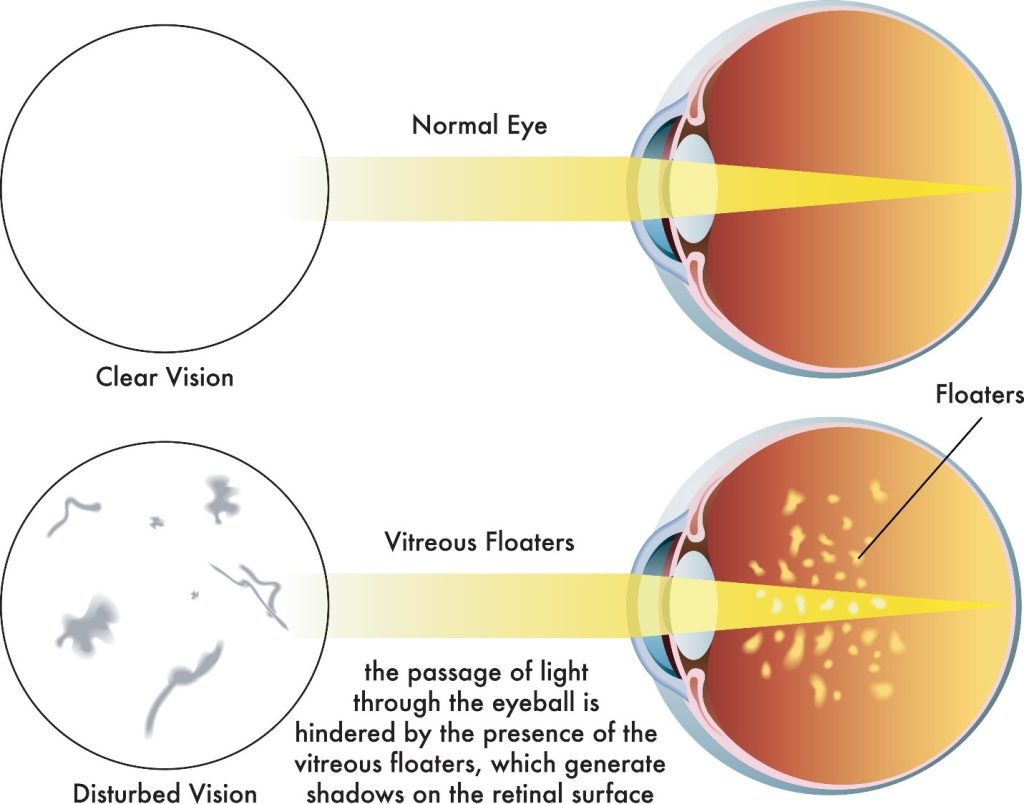


Many patients describe strange visual phenomena in front of their eyes. For some, these appear as small “floating spots” or “cobweb-like strands” that move along with their gaze. For others, they look like bright flashes or lightning-like streaks.
Should we be worried about these symptoms? Let’s clarify what is harmless and when you should see a doctor immediately.
What causes flashes and “floaters”?
Inside our eye there is a gel-like substance called the vitreous body. With age, this gel changes its structure, becomes more liquid, and small particles begin to float within it. These are what we see as “spots,” “threads,” or “floaters.”
A “flash” occurs when this gel-like substance pulls on the back wall of the eye — the retina. The retina interprets this mechanical irritation as a light signal, which makes us feel as if a lightning streak or flash appeared in the eye.
When is this considered normal (relatively harmless)?
-
If you have had floaters for years and their number has not changed
-
If they appear mainly when looking at bright light or a white wall
-
If flashes occur only with sudden eye movements and disappear quickly
When should we start to worry? (Warning signs)
There are so-called “golden hours” when a visit to an eye doctor is crucial to preserve vision. See an ophthalmologist the same day if you experience:
-
A sudden “shower” of floaters: many new spots or dark specks appear at once
-
Intense flashes: flashes become frequent, bright, and persistent
-
A “curtain” in your vision: a dark shadow or area appears in part of your visual field and does not go away (a classic sign of retinal detachment)
-
Sudden decrease in vision
Important
These symptoms may indicate a retinal tear. In such cases, timely retinal laser treatment can prevent retinal detachment and the need for complex intraocular surgery.
What should you do?
If you notice new flashes or floaters, do not wait for them to disappear on their own. A simple and painless dilated eye exam allows the doctor to determine whether your retina needs treatment.
Remember: Prevention is much easier and more effective than treatment.